
SERVICES
Supporting development.
Putting assemblies to the test.
Hands-on support for system concepts, integration, confidence testing and the assembly of prototypes and small systems.
We work directly on your setup – from building assemblies together to running development trials and interpreting the results. A development partner by design, not a test laboratory: our confidence testing provides clarity early, before formal qualification begins.
01 / CONSULTING
A view of the complete system.
Bringing requirements, system concepts and integration together.
We support the development of a coherent overall concept: from the intended application and selection of suitable components to their interaction within the target platform.
System concept
Translate the operating scenario and viewing task into technical requirements. Consider sensors, image processing, displays and operator controls as parts of a complete system.
Integration
Coordinate mechanical integration, power supply, data and video interfaces. Account for installation space, weight, power consumption and heat dissipation early in the process.
Overall concept
Bring interfaces and dependencies together. Plan integration steps, the test setup and evaluation criteria so that the interaction of the components can be assessed systematically.
OUR EQUIPMENT
Development trials and assembly.
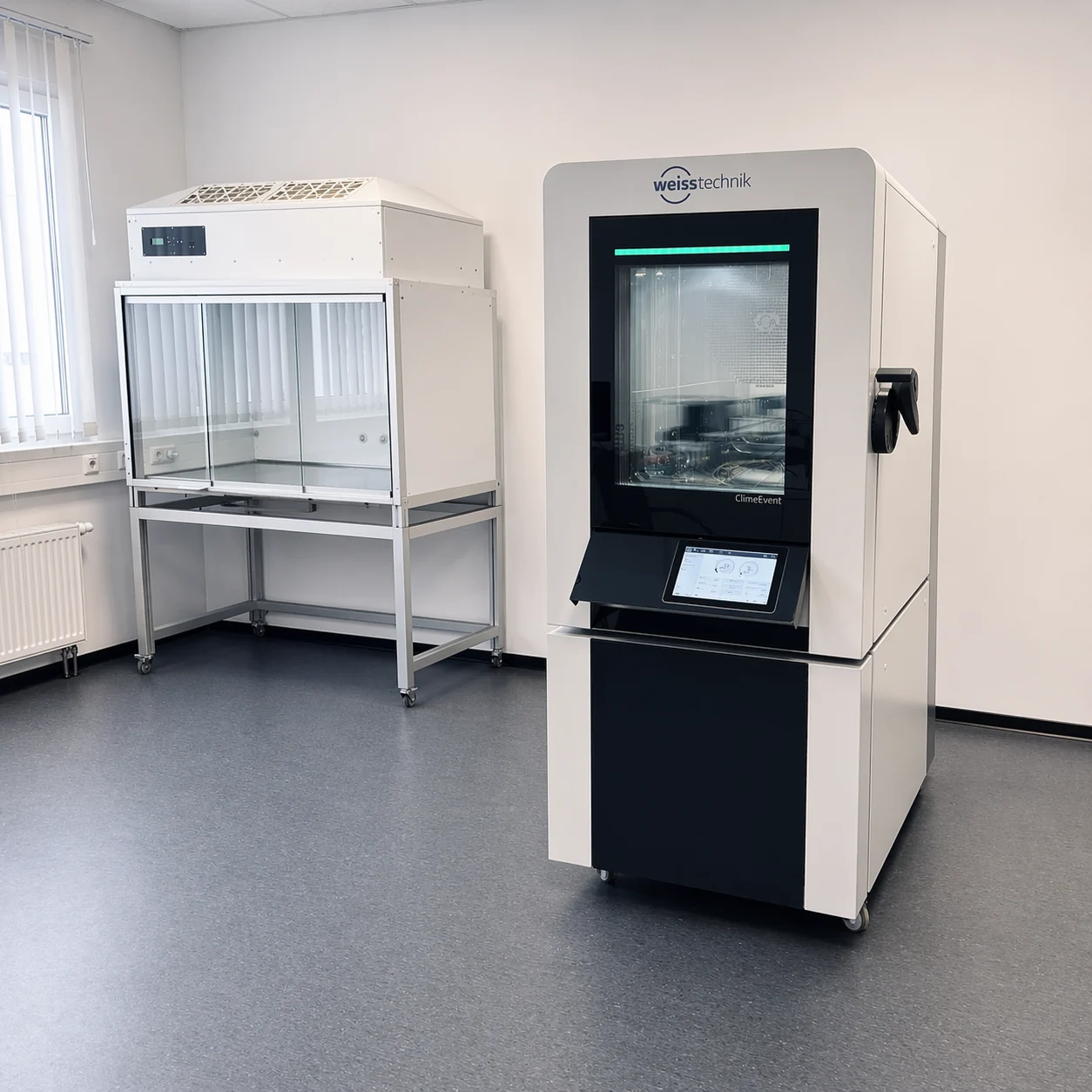
A view of our workspace.
The ClimeEvent C2/180/70/3 and the assembly workstation beneath the FMS 75 SuSi® support the testing and assembly of prototypes and small systems.
02 / CONFIDENCE TESTING
Assess behaviour under
temperature and humidity.
Weiss Technik ClimeEvent C2/180/70/3
We use the climatic test chamber for development-stage confidence testing. Working with you, we evaluate prototypes, assemblies and small systems under agreed temperature and humidity conditions. Constant conditions and cyclic temperature and humidity profiles help identify issues early and assess design changes.
| Temperature operation | −70 to +180 °C |
|---|---|
| Climatic operation | +10 to +95 °C |
| Relative humidity | 10 to 98 % RH within the permitted climatic operating envelope |
| Test space (H × W × D) | 750 × 580 × 450 mm |
| Loading | Max. 130 kg in total; max. 30 kg per shelf |
| Temperature change rate | Cooling: 3.8 K/min · Heating: 3.5 K/min |
Manufacturer data for the standard configuration; change rates under manufacturer test conditions. Humidity control is not available across the entire temperature range. Achievable rates and conditions at the specimen depend on loading, heat dissipation and the test setup, among other factors.
Planning the development trial
We start with a specific development question and agree the dimensions, mass, operating state, heat dissipation and cable routing of the assembly. Together, we define temperature profiles, humidity, dwell times, observation and measurement points, and documentation. The findings inform the next development steps; they do not replace formal qualification or certification.
03 / PROTOTYPES & SMALL SYSTEMS
Assembly under
filtered airflow.
SPETEC FMS 75 SuSi® laminar flow module
A workstation beneath a laminar flow module is available for assembling prototypes and small systems. The directed, filtered airflow reduces particle ingress in the working area, for example when assembling sensitive optical or electronic components.
| Filtration | H14 HEPA filter; at least 99.995 % separation efficiency at MPPS |
|---|---|
| Airflow | Directed clean airflow over the working area |
| Airflow adjustment | Eight selectable levels with airflow velocity display |
| Operating modes | Night setback and purge function |
| Filter dimensions (W × D) | 1,220 × 610 mm |
Manufacturer data. The filter class describes the filter; particle cleanliness and the usable assembly area also depend on the enclosure, surroundings, setup and working practices.
Planning the assembly
Component dimensions, cleanliness, tools, assembly sequence and protection of exposed optical surfaces are agreed in advance. Requirements for particle cleanliness, ESD protection and documentation are defined to suit the specific assembly.
The task defines the scope.
Whether the task involves a system concept, development trial or assembly, we work with you on the engineering challenge and agree the practical next steps directly.